
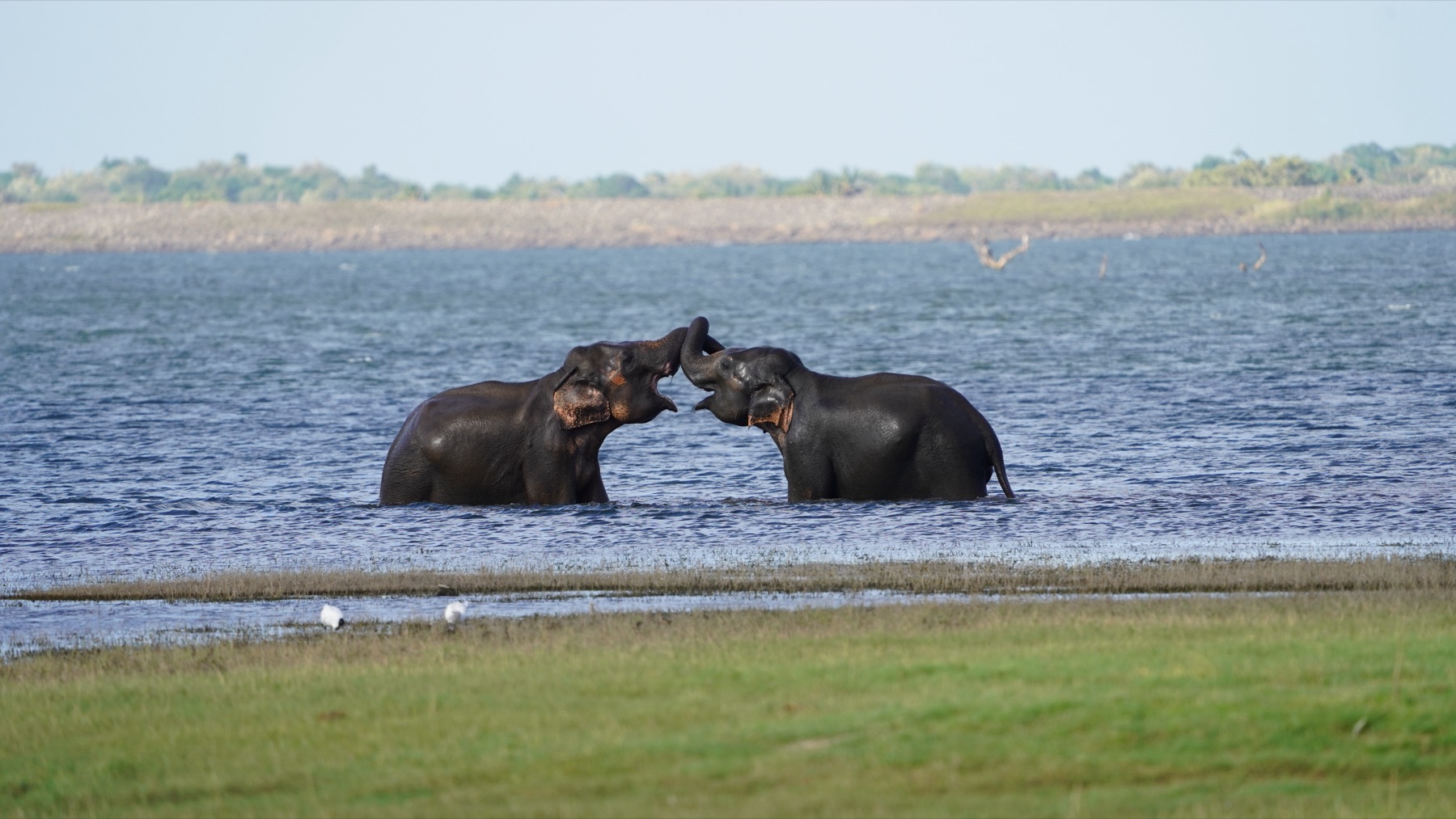
There is a saying in Sinhala that watching elephants and traditional rituals never becomes boring. That is exactly why we are getting ready today to visit a place where we can watch elephants to our heart's content.
Sri Lanka has many national parks where elephants can be seen. Whether you visit Yala, Kumana, Wilpattu, or Udawalawe, there is always a chance of seeing elephants. But seeing one, two, or three elephants is not enough, is it? If we are going to watch elephants, we should be able to see at least a hundred or two hundred of them.
Of course, when we say that, one might wonder whether there is really a place where such a large number of elephants can be seen at once.
Today, we are taking you to such a national park - a place where large herds of elephants can be seen in one setting. That place is Kaudulla National Park. If you visit Kaudulla, you can enjoy watching elephants as much as you like.
Some time ago, while speaking with Mr. Anil Vithanage, the Assistant Range Officer and Deputy Park Warden of Kaudulla National Park, he invited me to visit the park.
"Anura, come to Kaudulla one day and see the elephants," he said.
When a friend makes such an invitation, it is difficult to refuse. So, during a period when rain was falling across most parts of the country, we arrived at Kaudulla, bringing the rain with us.
Usually, if you want to see elephants at Kaudulla, it is better to arrive at least after 1.00 p.m., because the elephants move towards the tank plains in the evening. However, by the time we reached Kaudulla, it was already past 3.00 p.m.
Vehicles entering Kaudulla National Park must normally leave the park by 6.00 p.m. Since we arrived late, we had less than three hours to spend inside the park. Therefore, we quickly completed the necessary permission process and entered the park with a wildlife guide.
"Sir, because of the rain these days, the roads near the tank plains are very muddy," he told us.
From those words alone, we understood the condition of the tracks inside the park.
"It does not matter if the roads are muddy. Just take us to where the elephants are," I told him.
After driving a few kilometres from the main entrance, we took the first turn towards the tank plains, hoping to see elephants as soon as possible. After travelling through the forest for a short distance, we entered the open area near the tank. What we saw there was a road system full of muddy pits.
More than a hundred safari jeeps visit the tank plains on some days, and with the rain, the tracks had become extremely muddy. To be safe, I engaged four-wheel drive before going further. It was better than getting stuck in the mud and struggling later.
As we moved along the edge of the tank, we saw two lone elephants grazing. They were standing quite far away from each other.
"Those are two male elephants. They usually stay alone," our guide, Sampath, explained.
After moving just a few more metres, a huge elephant suddenly came out of the forest, lifting its tail and spreading its ears, and blocked our path. Since we could not predict its behaviour, we stopped the vehicle for a while.
A few moments later, a group of elephants crossed the road in a line. Only then did we understand what had happened. The first elephant had given us a warning and stood guard until the others crossed safely.
Elephants protect their young just as our mothers protect their children. If there is a small calf in the herd, the others usually surround it and keep it safe. It is said that the herds are mainly made up of female elephants, while male elephants are separated from the herd when they grow older.
While listening to these stories, my eyes suddenly turned towards Kaudulla Wewa, because the tank looked incredibly beautiful. The trunks of old trees, which had been submerged when the tank was created, still rose above the water, creating a strange and charming view. As the sun began to set, the beauty of the tank became even greater. We did not forget to capture a few photographs of that scene.
Since we had come to Kaudulla Wewa, it is worth listening to the story behind the tank as well.
It is said that King Mahasen built Minneriya Wewa during the period between 274 AD and 301 AD. According to folklore, during the same period, Princess Bisobandara, the sister of King Mahasen, secretly built Kaudulla Wewa at night with the help of Krishna, a minister of the king.
There is also a story that a talking crow lived in the royal palace. This crow revealed to the king that the tank was being built secretly. Because of this, the crow was impaled and killed at the same tank. It is said that the tank where the crow was impaled later came to be known as Kaudulla.
As we listened to these stories, we suddenly found ourselves close to a herd of about 50 elephants. These elephants seemed calm and unbothered. They were eating peacefully, and we were watching them quietly from a distance.
Several other safari jeeps were already there when we arrived. Most of them were carrying foreign visitors. In elephant herds, individuals of different age groups can be seen. A little further away, we noticed two male elephants and one female elephant, so we moved closer to observe them.
After looking at their body features, our guide Sampath told us that both male elephants were in musth. It seemed that two males were competing for the attention of one female. Since the female was standing close to one of the males, it was easy for us to identify the one who had won her affection.
We learned that such struggles for love among elephants can sometimes last for days, weeks, or even months.
If we had several hours to spend, there would be countless elephant stories to listen to. Since we had come to Kaudulla to see elephants, it is also useful to know a little about the national park itself.
Before Kaudulla became a national park, local people used to show visitors the elephants that came to Kaudulla Wewa. However, the government did not receive any income from that activity. Therefore, on 1 April 2002, Kaudulla was declared as the 15th national park in Sri Lanka.
Kaudulla is also very important in terms of genetic diversity. During the period from around April to October, elephants from different areas such as Somawathiya, Wasgamuwa, and Angammedilla gather at Kaudulla. Since elephants from different regions meet and breed here, Kaudulla becomes an important place for the birth of healthy elephants.
The Kaudulla Reservoir, which has a capacity of about 10,400 acre-feet, is said to provide water for around 13,000 acres of paddy fields.
Apart from elephants, Kaudulla is also a good place for birdwatching. Visitors can see different types of birds such as cormorants, painted storks, Asian openbills, and grey herons.
So, if you ever get the chance, visit Kaudulla National Park and enjoy a different kind of wildlife experience.
Finally, we would like to express our special thanks to Mr. Anil Vithanage, Assistant Range Officer of Kaudulla National Park, for helping us make this journey a success.