A few days ago, we travelled to Ekgal Oya in the Ampara area. Today, we are getting ready to visit a place with a similar feeling, but this time our journey takes us towards Tissamaharama.
In Tissamaharama, we have a friend named Malith Buddhika, who is a friend of Yasas. For a different kind of travel experience, he invited us to spend a night in a small hut built on a tree, in a chena cultivation near the banks of Yodhakandiya Wewa. Since we had never experienced anything like that during our travels before, we accepted the invitation without any hesitation.
We travelled to Tissa through Ratnapura, and by the time we arrived, it was around 4.00 p.m. As usual, this journey too was done on motorcycles. Yasas, Sameera, Leen, and Lihiru also joined the trip.
After arriving in Tissa, we contacted Malith to find the chena where our overnight stay had been arranged. Unfortunately, he had suddenly been called away from the area due to an urgent work matter. Although he had tried to connect us with another person, that arrangement also did not work out.
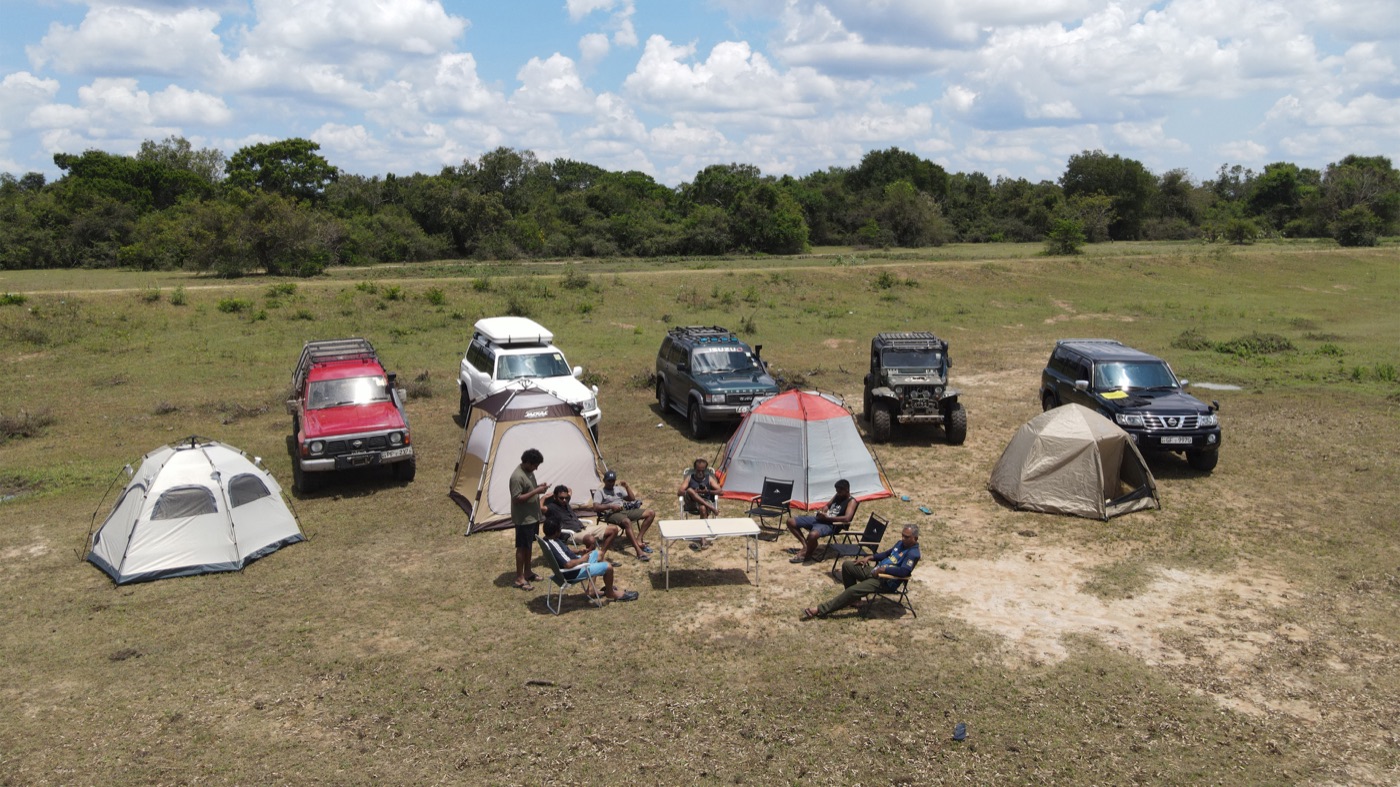
Since we had already come all the way, we decided to camp on the banks of Yodhakandiya Wewa instead.
After passing Tissamaharama and travelling a short distance towards Kataragama, we reached Tanikirigama Junction. From there, we turned right and passed Bandakkapelesssa and Mahagala before reaching Gurugodella. We had travelled about two and a half kilometres from the main road into the interior.
Around the Gurugodella area, we searched for a suitable place along the tank bund and started setting up our camping tents. During these days, the Maha monsoon rains were active in this region, and by evening, the sky was already heavy with clouds.
When camping in an unfamiliar area, it is always wise to build a small connection with one or two people living nearby. So, while the others were setting up the tents, Sameera and I walked towards the nearby chena fields to speak with the people around.
As we walked, we came across a chena cultivated by an elderly couple. They were Mrs. Sirimawathi and Uncle Gunadasa, both over sixty years of age. The two of them had taken the chena on lease and were carrying out chena farming there.
After exchanging a few friendly words and sharing details about where we had come from, they became very warm and welcoming towards us. In fact, they became so friendly that they even introduced us to Ranjith Aiya, who was staying in the neighbouring chena. From that moment, they gave us excellent support.
That night was a moonlit night. When the moonlight fell across the water of Yodhakandiya Wewa, the whole place gained a magical beauty. In the distance, the lights of Tissa Wewa Temple could be seen, and their reflection fell beautifully on the waters of Yodhakandiya Wewa. It was a scene that brought a deep sense of peace to the heart.
However, to experience that beauty properly, one should visit on a night when the moon is visible.
In the past, Yodhakandiya Wewa is said to have existed as two separate tanks: Yodha Wewa and Chithra Vila Wewa. Over time, these two tanks naturally joined together and formed what is now known as Yodhakandiya Wewa. According to history, this tank was built by King Kavantissa.
Yodhakandiya Wewa does not receive water from a major permanent stream. Instead, the overflow water from Tissa Wewa flows into Yodhakandiya Wewa. During the rainy season, water is also supplied by seasonal streams such as Delikanu Ara and Maha Ara, which become active only when there is enough rain.
That night, Ranjith Aiya from the neighbouring chena left aside his usual duty of guarding the field and joined us at the campsite. Around 11.00 p.m., we heard several elephant crackers being fired from about 700 to 800 metres away from where we were.
"Mahattaya, there are four elephants that came from Yala," Ranjith Aiya began to explain. "They have been here for about seven or eight years now. They must have come to the upper chena area tonight."
He continued, "There is a place on the Kirinda road where the Tissa council dumps garbage. These elephants have got used to eating that garbage. That is why it is difficult to send them away. The Wildlife Department says that even if they are taken back to Yala, they will return again."
According to Ranjith Aiya, if those four elephants were not there, the chena farmers would be able to cultivate their lands much more peacefully.
To see the true beauty of the night sky, one must stay awake until around 2.00 a.m. The charm of the star patterns spread across the dark sky was captured several times through Yasas's camera lens.
A tank shows its beauty in two special moments: in the evening and in the morning. If you spend a night beside a tank, you are lucky enough to experience both. Yodhakandiya Wewa gave us exactly that kind of unforgettable experience.
There is also a season when birds arrive at Yodhakandiya. According to Uncle Gunadasa, migratory birds begin to arrive around January. Different types of migratory birds visit the tank and remain there until the end of April.
With those memories, it is now time for us to say goodbye to Yodhakandiya Wewa. We hope to meet again another day from another beautiful corner of Sri Lanka.